 |
How fungal spores enter the sinus and lungs.
|
Fungal infections were new to us. We knew of them, since before and after Todd's first allogeneic bone marrow transplant in September 2014, but fortunately, Todd had never had one until now. There was so much we needed to learn.
At first, we were told that they are 1) hard to fight; 2) can take weeks or months to get rid of; 3) can be invasive and can spread. This is why it took so many tests: x-rays, CT scans, and MRIs, and the biopsy to confirm the diagnosis. If left untreated quickly, it can be deadly.
One of the better articles on the subject is and is referenced at the end of this post. If you are going to any reading beyond this blog on the subject, I would recommend it as a starting point. I want to pause here to include an interesting paragraph:
The increase in the incidence of IFI has resulted in a substantial increase in the length of hospital stays and healthcare expenditures [Morgan et al. 2005; Dasbach et al. 2000]. As an example, compared with cancer patients without aspergillosis, cancer patients with this disease stayed in the hospital for an average of 26 more days (33 vs. 7 days), incurred US $115,262 more in total costs on average, and had four times the mortality rate during hospitalization (31% vs. 7%) [Dasbach et al. 2000]. (Bhatt, Viola, and Ferrajoli, 2011, Epidemiology, par. 3).The reference made here that an increase in Infectious Fungal Infections (IFI) is due to the "increasing frequency of infection by non-Aspergillus molds (e.g. zygomycosis) and the emergence of drug-resistant fungal pathogens." (Bhatt, Viola, Ferrajoli, 2011,Abstract). I also found it interesting, in this one example, that the cancer patients stayed an average 26 more days in the hospital. Todd was diagnosed solely on a fever and a little jaw/facial pain. He was admitted on November 5, 2016 and we are hoping he will discharged on November 29, 2016, a total stay for 24 days; uncannily close to the 26 days in this example!
Treatments
I wanted to discuss the three types of treatment used to treat fungal infections: antifungal medications, hyperbaric treatments, and white cells. In Part 1 here I will explore the first treatment:
1. Heavy duty antifungal medications for long period of times.
They can try to give specific antifungals if they can determine the type of fungus, but this often takes weeks for anything to grow in a culture. In Todd's case, one of his cultures grew a Penicillium fungus used to make penicillin, however, it is extremely rare for this to actually be the type of fungus found in the sinuses. It is usually only contracted in Eastern Asian countries like Thailand, northeast India, China, etc. (Chen, et al. 2013, n.p.). So, the infectious disease doctors were very skeptical that this type of fungus grew from the biopsy of Todd's sinus. Instead, they think it came from a contaminate from the lab that landed onto the petri dish and grew. The most common strains come from molds and yeasts and are too numerous to recite here. While Todd was already taking a prophylaxis or preventative antifungal medication like Voriconazole while his white counts and ANCs were at zero, it wasn't enough to keep him from getting a fungal infection.
The million dollar question: How did he get it?
It is likely that he got the infection from simply breathing spores in the air that everyone typically breathes in. Normally, it wouldn't bother a healthy individual, but for immunocompromised patients like Todd, it can be dangerous. Todd does however, fall into the "High Risk Groups" (click link), in three categories: those with "Severe neutropenia (ANC) <0.1 × 10⁹/l for >3 weeks," those with use of "Corticosteroids >1 mg/kg and mild neutropenia (ANC <1 × 10⁹/l) for >1 week" (used to prevent reactions to transfusions), and has had "High-dose cytarabine or fludarabine" (used in the first leukemia induction chemotherapy. (Bhatt, Viola, and Ferrajoli, 2011, Table 1).
The million dollar question: How did he get it?
It is likely that he got the infection from simply breathing spores in the air that everyone typically breathes in. Normally, it wouldn't bother a healthy individual, but for immunocompromised patients like Todd, it can be dangerous. Todd does however, fall into the "High Risk Groups" (click link), in three categories: those with "Severe neutropenia (ANC) <0.1 × 10⁹/l for >3 weeks," those with use of "Corticosteroids >1 mg/kg and mild neutropenia (ANC <1 × 10⁹/l) for >1 week" (used to prevent reactions to transfusions), and has had "High-dose cytarabine or fludarabine" (used in the first leukemia induction chemotherapy. (Bhatt, Viola, and Ferrajoli, 2011, Table 1).
They had to change his IV anti-fungal medications a few times, but finally resolved on a course of the very strong Amphotercin B, also known as AmBisome, given by daily 425 mg intravenous infusions. According to the Wikipedia entry on Amphotercin B, it is used in "a wide range of systemic fungal infections," (Wikipedia, par. 4) and is often "the only effective treatment for some fungal infections." (Wikipedia, par. 1). So, apparently, it is the "go to" antifungal medication. It does have some nasty side effects. The first is called the "shake and bake" which is basically the chills and shakes. Todd never had this side effect; he has only got hot and sweaty. The side effects that Todd did have though were bad enough. He had chest tightening and a painful pulse in his tailbone. They doctors were finally able to get around this side effects with the use of three pre-medications: Tylenol, hydrocortisone, and Benadryl and by running the IV pump at a very slow rate over 4 hours. Apparently, he will have to receive AmBisome IVs everyday or every other day even after being discharged, on an out-patient basis or I may even have to give him the infusions at the hotel/apartment.
Why the sinus?
According to a journal article published by Bhatt, Viola, and Ferrajoli, sites of fungal infections included lungs, orbito-sinus-facial structures, and cerebral regions. The statistics were as follows:
In a study of patients with hematologic malignancies, the most frequent sites of mucormycosis were the lungs (64%) and the orbito-sinus-facial structures (24%), while cerebral involvement and disseminated infection were observed in only 19% and 8% of the cases, respectively [Pagano et al. 2004]. (As quoted in Bhatt, Viola, and Ferrajoli, 2011, n.p.)
It is such a nasty infection, that certain types can spread to the face, the eye, the brain, and even the skin. We were always concerned with the questions from doctors regarding pain in his face, differences in his vision, and the full body inspections looking for fungal infection on the skin. Todd decided to Google photos of invasive fugal infections and here are a few of the photos he found on what they can do. TODD DOES NOT HAVE AN INVASIVE FUNGAL INFECTION LIKE THESE PHOTOS! His was caught very early. This is what they can do:
 |
| Invasive Fungus Sinusitis: Medscape 2000 |
 |
| Fungal Infection in Eye/Orbital |
Mukherjee, B., Raichura, N., Alam, M. 2016.
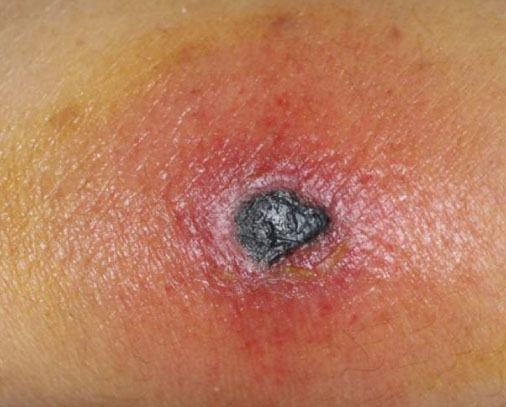 |
| Fungal Skin infection (mild): No JH, Yu JS, Kim EO, et al. 2010 |
You can understand the doctors concerns with fungal infections and treating them quickly and thoroughly! Todd is very fortunate that his was caught extremely early!
Besides antifungal medications, the doctors have seen some success with hyperbaric treatments. I will explore this treatment in the next blog post.
References:
Amphotercin B, 2016. Wikipedia. Web. Retrieved from:
Bhatt, V., Viola, G, and Ferrajoli, A. Ther Adv Hematol. 2011 Aug; 2(4): 231–247. doi: 10.1177/2040620711410098 Web. Retrieved from: https://www.ncbi.nlm.nih.gov/pmc/articles/PMC3573411/
Chen, M., Houbraken, J., Pan, W., et. al. BMC Infectious Diseases 201313:496
DOI: 10.1186/1471-2334-13-496. Web. Retrieved from: http://bmcinfectdis.biomedcentral.com/articles/10.1186/1471-2334-13-496
Mukherjee B, Raichura ND, Alam MS. Fungal infections of the orbit. Indian J Ophthalmol. [serial online] 2016 [cited 2016 Nov 27];64:337-45. Retrieved from: http://www.ijo.in/text.asp?2016/64/5/337/185588
No JH, Yu JS, Kim EO, Choi HH, Kim SH, Kwon JC, Lee DG, Choi SM, Park SH, Choi JH, Yoo JH, Kim HJ, Min WS. A Case of Disseminated Aspergillosis Presenting Solely as Multiple Cutaneous Lesions in an Acute Leukemia Patient. Infect Chemother. 2010 Aug;42(4):244-248. https://doi.org/10.3947/ic.2010.42.4.244
Medscape General Medicine. 2000;2(1) "Fungal Sinusitis." Web. Retrieved from: http://www.medscape.com/viewarticle/408751_2
Mukherjee B, Raichura ND, Alam MS. Fungal infections of the orbit. Indian J Ophthalmol. [serial online] 2016 [cited 2016 Nov 27];64:337-45. Retrieved from: http://www.ijo.in/text.asp?2016/64/5/337/185588
No JH, Yu JS, Kim EO, Choi HH, Kim SH, Kwon JC, Lee DG, Choi SM, Park SH, Choi JH, Yoo JH, Kim HJ, Min WS. A Case of Disseminated Aspergillosis Presenting Solely as Multiple Cutaneous Lesions in an Acute Leukemia Patient. Infect Chemother. 2010 Aug;42(4):244-248. https://doi.org/10.3947/ic.2010.42.4.244


