Showing posts with label AML. Show all posts

Wednesday, March 15, 2017

TODD CADE WENT HOME TO BE WITH THE LORD MARCH 8, 2017


I apologize for not posting on this blog after we returned home from Houston, Texas.  Todd continued out-patient treatment and transfusions at our local hospital, Soin Medical Center, Beavercreek, Ohio, until mid-Febuary, when it came time to start his next round of chemotherapy.  By this point, Todd was having fevers every 6-8 hours around the clock.  We learned that his heart had suffered some damage from the induction chemotherapy given to him to combat the AML back in October, 2016.  We also learned that while the fungal infection in his sinus was gone, the infection in his lung continued to grow into a mass, and then spread even further parts of the lungs from there. 

His local oncologist here in Dayton, was leaving her practice to take a new position in PA.  None of the existing doctors, nor herself, felt that Todd was in any shape to continue to the next round of chemotherapy: 5 days of Decitabine with the experimental regimen of Veneteclax (an FDA approved drug for CLL and Xeljanz (a JAK3 mutation inhibitor in Todd's case).  His counts were extremely low, and what healthy marrow he had left was also being destroyed by the chemotherapy. 

He continued to lose significant amounts of weight.  With no doctor here in Dayton willing to take his case, we returned to The Cleveland Clinic on an inpatient basis the evening of February 10, 2017.  They did a thorough investigation into the fevers, to find out if it was the fungal infection or something else causing them.  They gave him antifungal IV medication everyday instead of three times a week.  They started him on IV antibiotics (Zosyn) around the clock every 6 hours.  The doctors there too concluded that Todd was too weak to undergo another round of chemotherapy, even though Todd's last bone marrow biopsy showed his blast counts had dropped to a remarkable 8%.  There was just not enough healthy cells to make enough good blood cells.  He received transfusions of platelets and red blood cells until the last few days, when the doctors finally decided that he was receiving no benefit from the platelets.  His counts would be like 3,000 in the morning and would only bump to maybe 7,000 in the afternoon, only to have them go back down to say 2,000 the next morning.  He body was just using them up to quickly. 

After a good week of tests and treatments, nothing new was discovered.  Their conclusion was that the fungal infection was the likely source of the infection.  His platelets were too low for a biopsy (nor removal) of the infection in his lungs, and even if they could determine the exact type of fungus, they doubted that they could give him any stronger antifungal, that what he had already been given.  Not only were they treating him with IV antifungals since diagnosis on November 5, 2016, but they added a second antifungal oral tablet called Cresemba about a month ago.  The medications could only do about 1/3 of the work to clear up the infection, his body's own immune system needed to do the rest or 2/3 but he had NO immune system of his own. 

By mid-week the doctors began to tell us the horrific news that they feared there was nothing else they could do for Todd.  Without continued Chemotherapy to treat the MDS, it would go unchecked and progress back to AML.  He blood counts would continue to drop to dangerous levels.  Without an immune system and in increase in his white and neutrophil counts, the fungal infection too would continue to grow at a faster rate than any of the medications could treat.  He was so weak, that he could barely stand up to go to the bathroom.  It was time to talk about "DNR" orders, Hospice, and what major decisions we wanted to make. 

It was devastating.  We laid in his hospital bed together crying; unsure about calling it quits.  We trusted the many doctors who came to talk to us, but we had been fighting this for so long, that it seemed unnatural to stop.  I knew Todd had been growing increasingly weaker since the first of December, and prayed we made it home to Dayton.  He confided to me that he knew it would be his last Christmas.  We cried some more.  Once we made the decision to take what quality time he had left and go home to be with our family, we couldn't leave fast enough.  We wanted to get home to celebrate our eldest daughter's 21st birthday that next day, February 24, 2017.

They discharged Todd from Cleveland Clinic on Thursday, February 23, 2017.  Praise God I was able to drive him home after they juiced him up with two days of platelet and blood transfusions.  We arrived at home that afternoon, where Hospice of Dayton had already delivered the Home Care bed and equipment, and where my brother and father already had the room ready. 

We were blessed to have him at home from that day until Tuesday, February 28, 2017, even though his fevers continued to rage around the clock in cycles of every 6-8 hours of chills, ice packs, and drenching sweats.  Todd was brought to the main campus of Hospice of Dayton that morning by ambulance to receive a blood transfusion to help relieve his symptoms of severe fatigue.  A Hospice Triage nurse had taken a blood draw from the day before and his hemoglobin had dropped to 6.1.  Unfortunately, as soon as Todd was taken from the bed in our home to the gurney, he was in pain and could not take a deep breath.  By the time we arrived at Hospice, he was in severe pain.  After an examination from the doctor there, we learned that Todd's splenomegaly was back with a vengeance.  We were not expecting this!  It was very hard at first for the team there to get his pain under control.  We decided to stay the night and maybe a few more days, until he was more comfortable.  They had tried to access his port for the transfusion, but were unable to.  So they had to set up a pheriphal line in a vein in his hand to give him IV pain meds and finish the 2 units of blood. 

By that evening, he was more relaxed and able to get some long term pain meds (methadone) and short term pain meds (dilaudid) around the clock.  Todd's mind was sharp and his memory spotless.  He was responsive and at times his usual witty self until Sunday, March 5, 2017, when we asked all visitors to stay away and allow just me and the kids to have personal time alone with him.  He asked us to say our peace and he told us his.  We cried together, shared our love for each other, and then he said he couldn't hold his eyes open anymore, he was so tired.  He said to call for the nurse; he wanted to take his scheduled pain medicine and go to sleep.  That night we hung out together as Todd mostly slept.  By Monday, he was much less responsive and couldn't really speak.  This was so hard.  By Tuesday, he was totally unresponsive and his breathing became very hard.  The kids said their evening goodbyes and I refused to go to sleep.  The Hospice nurses moved Todd to a position where I could climb into bed with him and sleep beside him throughout the night.  His breathing was so hard, that it shook the bed.  I was so happy to be with him, but my heart was full of regrets: that maybe there was still something else we couldn't have tried to save him; maybe that I should have been more encouraging to continue the fight and not give in to reality; the realization that he was the bravest person I knew to say goodbye to us on Sunday, and accept that he was going to die.  I couldn't have done this!  I loved him so much!!!

He chose 6:15 a.m. with just the two of us in the room to take his last breaths.  I couldn't believe he was gone.  I felt some peace that he was not in pain anymore, but then I was so sad that I lost the love of my life and our children lost the best father they could have ever had.  I regretted not appreciating him more! 

Here is the link to his obituary:
http://www.newcomerdayton.com/Obituary/133931/Todd-Cade/Dayton-Ohio

We laid Todd's body to rest on Monday, March 13, 2017.  We know he is not there.  He has gone on to his eternal reward with Christ our Lord.  Please continue to pray for the family as we grieve his absence. 

Here is the tribute I wrote and read at his funeral:


Todd gave me the best 25 years of his life! He was greatest husband and father we could have hoped for.  He was faithful, strong, and always made sure we were provided for.  When Todd and I made the decision that I would stay home to raise our kids, he took on extra hours at work by moving into a management position that often required 60 hours per week.  We never did without.  Even in the past two years while he was sick he helped me to sell a few cars on our own to provide some extra income to the family.  Todd always put us first.  He was the adventurous, risk-taker and I was the cautious and conservative one; we balanced each other out.  I was such a realist that he jokingly dubbed me the “dream killer.” His humor and quick wit was his charming tool to add fun to any situation or to disarm any conflict.  His years of service for Christ may have went unnoticed to this world, but not to those he blessed nor to his children, who saw him repeatedly give his limited time to church service to the Glory of God.  He lived his life on purpose and set out to be a blessing to others.  He was always positive and never complained about all the treatments and transfusions he needed these past years.  His optimism was contagious and even in his last weeks of life told the doctors he didn’t understand their pessimism and negativity!  He would have done anything, no matter the pain or cost to himself, if he could buy more time to be with his family.  He taught me so much about life and I had the greatest privilege to be intimately close to him as his wife these 25 ½ years. 
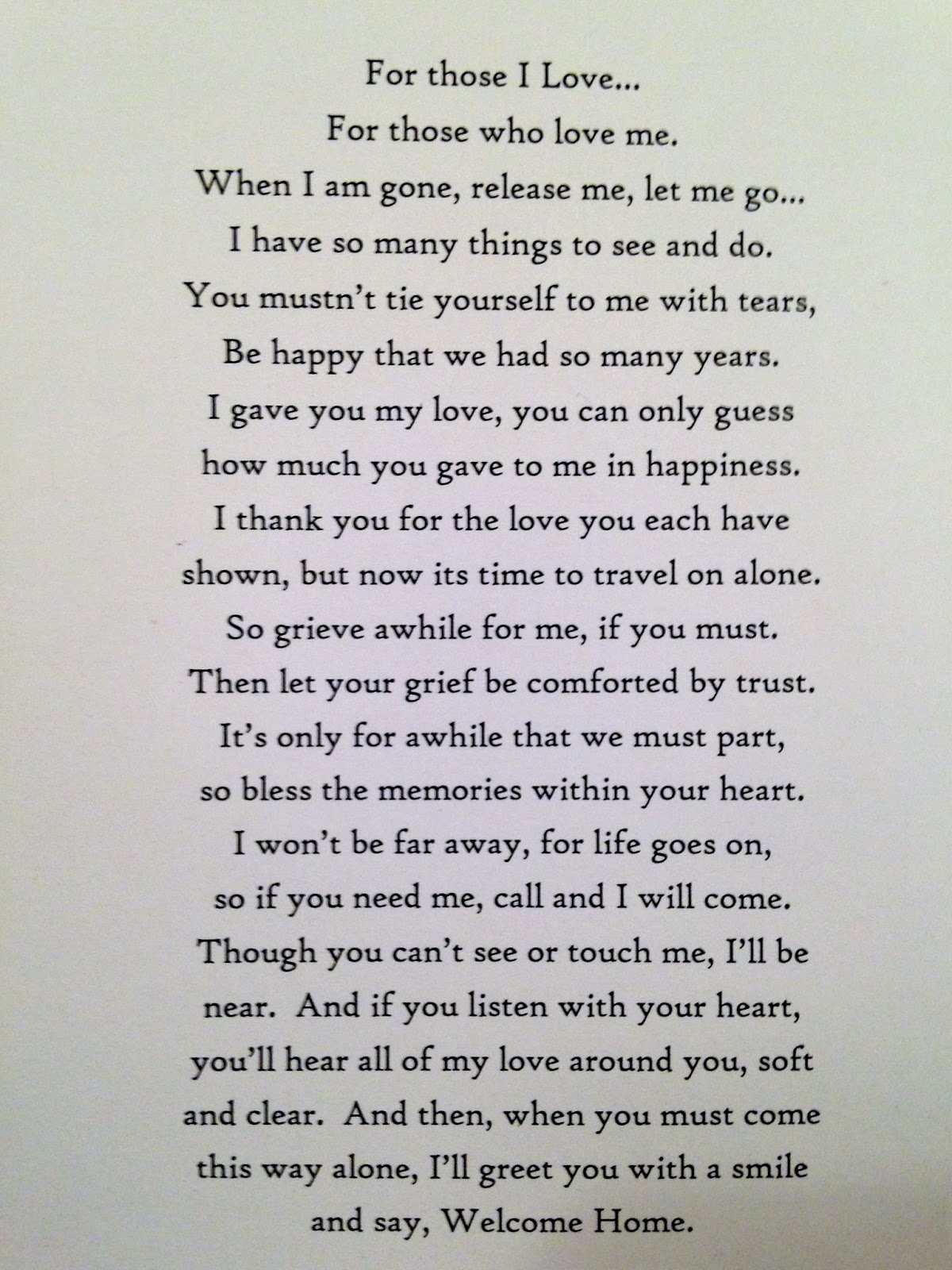
Todd was not very sentimental or romantic, but he still found ways to shower me with love.  He was a steady rock; an oak tree.  He didn’t write or journal much, or didn’t even leave any letters for the future, but If Todd was here, this is what I imagine he would say:

Don’t stand here and cry for me,

I am not here.  This is just the body that housed my spirit and my soul 

I am still with you.  I live on in your memories and through my children; be good to them.

Love them like I would and be there to comfort and support them when they need it. 

I am no longer suffering and we will all be reunited in the Hope of the Resurrection Christ has given to us.

My life was full and fulfilled in every way.  I have no regrets, only gratitude for the life and love that I had.

I love you all. Be full of joy; savor every precious moment of time together; and follow your dreams.
I did recently find a journal in which he wrote a few pages in during our Epic Road Trip out West in 2012.  IT was his bucket list goal and Dream.  (I read a few passages; omitted here).

  I love you Todd!

Wednesday, October 26, 2016

October 18, 2016 Todd is discharged from Hospital

Todd was discharged and We were able to leave the hospital late in the day. He had another lumbar puncture and intrathecal chemo treatment this morning. We also learned that they found no cancer cells in the first lumbar puncture!  So that's good news. Todd was a bit tired and nauseated getting to our hotel room but we are settling in hopefully for the next 12 nights. Here is a pic of Todd with one of his nurses Mike who liked to talk Football. This was his bed and our room on the Leukemia Floor.

October 16, 2016 Second LP and Intrathecal Chemo

Because the doctors rounded so late today, they are not going to release Todd until tomorrow afternoon, after they do his second Lumbar Puncture and Intrathecal chemotherapy.

Our social worker has a arranged for us to stay in a hotel nearby for 12 days.  Starting October 30, we will need another place to stay.  I think I found us a small apartment through Eagle's Life Ministries. It is still about 10 miles or 30 minutes away. So, we will need to see if that is close enough.  There are so many complications that can happen, I would rather be closer like 1-2 miles away, but I'm just not sure if we can find something other than a hotel.  Even the small efficiency apartment would cost us $900 per month. All the other places have a 2-3 month waiting list and a hotel every night could get expensive.  Praying for open doors and information.

October 15, 2016 Chemotherapy is done.

Chemo is done!  Todd will likely be discharged on Monday notwithstanding any complications. He still needs transfusions daily so I'm not sure how that is going to work coming in every two days. The low Hemoglobin is not so much a problem if he has to wait a day, but his platelets have been under 10,000 for days. Even with multiple platelet transfusions yesterday they could only get his count up to 7,000. We will likely be staying in a hotel nearby for the first few days to weeks. Pray that God will handle the logistics and keep Todd protected from a bleeding incident or hemorrhage. Pray that the find a donor quickly.  The kids have already completed their HLA blood work along with his other brothers.  Now we wait...

Wednesday, October 5, 2016

Acute Myeloid Leukemia with MDS Diagnosed; Treatment Decided Oct 4, 2016


 Induction chemotherapy -
Chemotherapy given to induce a remission. 
      This term is commonly used in the treatment of acute leukemias.     Chemocare.com 2002-2016

After 6 days at MD Anderson Cancer Hospital, the doctors finally had enough information from the test results to make an official diagnosis and propose a game plan for treatment.  On Tuesday, October 4, 2016, Dr. Benton came by in the morning with the much anticipated bone marrow results.  Todd's blast counts were at 21% which officially puts him into the diagnosis of MDS with Secondary Acute Myeloid Leukemia (blasts > 20% in the bone marrow).  While the full genetic panel was not back, the bone marrow flow cytometry report revealed a positive major genetic mutation marker known as CD56, also known as NCAM1, Neural-Cell-Adhesion-Molecule 1.  This mutation stems from a translocation of the 8 and 21 chromosomes [t(8;21)].  Having this mutation puts Todd at risk of the Leukemia infiltrating the blood/brain barrier and entering the central nervous system.  The Transplant Fellow explained it as follows:  There are very few or no cells in the spinal fluid sac that surrounds the brain and spine.  You usually don't find any white or red cells in there.  With this mutation, the blast cells CAN penetrate this barrier and can be found in the spinal fluid.  AS A PRECAUTION, they will do a "lumbar puncture" or spinal tap to collect spinal fluid for testing, to see if it tests positive for blasts.  As an additional precaution, they don't wait to get the results back to treat this area.  Instead, they need to replace the fluid they remove with something else to avoid a spinal headache, so they insert a type of chemotherapy into the spinal fluid to kill any potential blasts cells there.  Of course, we already know that Todd has the TP53 genetic mutation that makes it more resistant to treatment and he has the IDH1 mutation. 

To treat the AML, Dr. Benton and his colleagues recommended using a study trial regimen available only at MD Anderson. (Trial #2012-1064).  Instead of the standard of care treatment given everywhere else, known as the 7 + 3, where they give 7 days of cytrabine and 3 days of daunorubicin, they will use four drugs in a 5 + 5 day trial treatment called Decitabine + CIA

The first 5 days they will give him a drug called Decitabine a Hypomethylating Agent (HMA) used to prime the leukemia cells to accept the other drugs.  Then they will give the CIA:
Clofarabine 5 days, Idarubicin 3 days, and Cytarabine (Ara-C) 5 days.  The Idarubicin is given less days because it poses the most toxicity, especially to the heart. 
According to the Trial information posted on clinicaltrials.gov, the following regimens are possible:


Drug: Decitabine     Purpose:
Other Name: Dacogen (DAC)
Purpose: Designed to damage the DNA (the genetic material of cells). This may cause cancer cells to die. 
Phase I and II - 20 mg/m2 by vein daily for 5 days (days 1-5)

Drug: Clofarabine
Other Names:
  • Clofarex
  • Clolar
Purpose: It is designed to interfere with the growth and development of cancer cells.
Phase I Starting Dose - 15 mg/m2 by vein daily for 4 days (days 6-9)
Phase II Starting Dose - Maximum tolerated dose from Phase I (number of days selected based on Phase I portion).

Drug: Idarubicin
Other Name: Idamycin
Purpose: Designed to damage the DNA (the genetic material of cells). This may cause cancer cells to die. 
Phase I and II - 10 mg/m2 by vein daily for 3 days (days 6-8)

Drug: Cytarabine
Other Names:
  • Ara-C
  • Cytosar
  • DepoCyt
  • Cytosine Arabinosine Hydrochloride
Purpose: Designed to insert itself into DNA and stop the DNA from repairing itself.
Phase I and II - 1 g/m2 by vein daily for 5 days (days 6-10).  Clinicaltrials.gov, 2016.
                    
    We have not been told whether he will be part of Phase I or .  The whole intention of this "induction" chemotherapy is to get the Leukemia into remission.  The most upsetting revelation of this remission is that with AML, remissions are short-lived, and each time there is a relapse of disease, another remission will be harder to achieve and will be of a shorter duration.  The first remission after the first induction usually lasts <6 months.  According to Texas Oncology, "If a complete remission is achieved and no further therapy given, over 90% of patients will have a recurrence of disease in weeks to months."  (Texas Oncology.com 2016).  Because of this realization, we have agreed with Dr. Benton that Todd will have this induction with the intention of pursuing a Second Bone Marrow Transplant as soon as possible. 

    It can be difficult though to get a non-related donor lined up in a short period of time.  When Todd had his first transplant, he was fortunate to have a perfect match with his brother Tom.  However, since Todd relapsed so quickly after the transplant, they would rather use a non-related matched donor this time.  Dr. Benton brought in a transplant doctor and a fellow here at MD Anderson to consult in the matter.  They came by today to discuss transplant options.  It was his opinion that finding a non-related donor from the National Bone Marrow Registry who would be ready to donate, (Be the Match) may take up to 3 months!  It was his opinion that we did not have that long to wait if at all possible. 

    After the first induction, they like to wait for the bone marrow to recover but not long enough for the cancer to return.  In this case, they could do a second round of chemo called "consolidation" until the bone marrow donor is found and ready to donate.  For this reason, he was very interested in screening our three kids to see if one of them would be a haplomatch (half full match).  Abby, was screened at registered when S.A.M./Sharing America's Marrow came to the University of Cincinnati to recruit donors during her freshman year.  She actually volunteered with Sam and her sister during their visit. 

    Consolidation chemotherapy -
    Chemotherapy given once a remission is achieved. 
    The goal of this therapy is to sustain a remission. 
    Consolidation chemotherapy may also be called intensification therapy. 
    This term is commonly used in the treatment of acute leukemias. Chemocare.com 2002-2016

    We would have the option to have the transplant here at MD Anderson or back at the Cleveland Clinic.  However, traveling after induction can be risky.  In addition, MD Anderson has more options here than Cleveland does.  They may have different pre-transplant conditioning and/or suppression therapy after transplant than Cleveland.  Also, if Todd was to relapse once again after transplant, there are more trial and treatments options here for him.  For this reason, we have asked Dr. Hamilton at the Cleveland Clinic to transfer the donor search from there to here.  The team here will continue the search, including sending screening kits to our three children. 


    I took Todd downstairs today to the MD Anderson Hair Salon for Patients.  He wanted to have his head shaved before starting the chemotherapy.  The Salon is ran by the Volunteer Services Department, but the wonderful hair stylists there are paid by the department.  They will wash and style hair, or trim or shave hair and they assist with wig selection and styling.  Todd is still handsome without his hair!

    After getting the insurance approval today, the trial nurse came by to discuss the treatment with us and have Todd sign the consent.  We knew we would work well together when she asked Todd if he was a Bengal's fan!  Her husband is from Cincinnati and she has been converted too! 

    The thing I found the most upsetting when discussing Todd's treatment was the topic and discussion of putting Todd is "Protective Environment" after the first round of chemotherapy induction.  It is something that is only done here, because they have always done it this way.  They gave us two options: the Protective Environment or Discharging him on the Fast Track.  From one extreme to another.  PE is when they put patients  50 years or older with AML just off of induction therapy in a special room for over 20 days, where there is no bathroom, a special HEPA filter, no family allowed inside, etc. to help protect the patient from getting infection and being able to detect and treat a fever or infection right away.  I would only be allowed to come visit in a visitor's room connected to Todd's room where I could speak to Todd only through a glass window between.  I could not touch him or help him.  But, doctors, nurses, cleaning people, and the food service people would be allowed to come and go with proper attire (shoe covers, protective clothing covers, masks, and gloves) but not any family!   There is no real research or data that "proves" that PE is more effective. Even though Todd is only 47, he is close enough in age for them to think PE was a good idea.

    I thought it was a bad idea, because of the lack of mental and physical support the isolation would cause.  Todd and I have been through a lot together and I can't imagine not being there to help him, comfort him, hug him, and encourage him.  He felt the same way.  If he goes into transplant after treatment, he will have to stay in the hospital another 30 days. 

    On the other spectrum, the Fast Track program would allow Todd to be discharged right after chemo induction and then he would have to return every two days for treatment like transfusions, check-ups, etc.  We would have to stay within 10 minutes of the hospital in case Todd spiked a fever over 100.9; he would have to brought in within 30 minutes even if it was just a neutropenic fever and not an indicator of an infection.  Apparently, an infection can take hold fast. Any fever over 100.9 would always necessitate being admitted.  It is not uncommon for these patients to be admitted several times during the Fast Track process.  He would have to be readmitted at some point when the transplant conditioning begins and/or if consolidation therapy was needed (not sure about this). 

    This made the decision difficult.  Finally, we got a social worker to come in and talk to us.  She said that we had the right to say what we wanted to do and that some patients in the past was able to do a "modified environment" where we could just stay in a regular room like now on the leukemia floor.  She said she wishes she would have been here when the doctors were rounding and she could have told them of this other option.  Today, when the doctors rounded, we just told them that we didn't want Todd to go to PE; instead we preferred a modified environment.  So, hopefully, this has been accepted.  We will see. 

    The social worker gave me a substantial list of places to stay nearby.  I have to start calling right away to get on several waiting lists.  Even if we don't do the Fast Track option, we still will need housing post-transplant. 

    I know I am probably forgetting to include so many other things but that is all I have time to blog now.  I will say that Dr. Benton hopes that the size of Todd's spleen could start going down soon after he begins the induction therapy.  This would be a big bonus!  He would be able to get off some of the major pain medicine he has been on the last couple of weeks, just to cope with the pain of the enlargement. 

    It is late, and Todd was able to start his first round of Decitabine tonight about 9:00 p.m. DAY 1 Cycle 1. They started him on 42 mg (amount adjusted according to Todd's weight) at 50 ml/hour.  No transfusions were needed today, Wednesday October 6, but he had one unit of blood yesterday, Tuesday, October 5, 2016. 

    References:

    Chemocare.com  2002-2016.  "Chemotherapy Terms." Cleveland Clinic. Web. Retrieved from: http://chemocare.com/chemotherapy/what-is-chemotherapy/chemotherapy-terms.aspx

    ClinicalTrials.gov.  April 26, 2016. "Decitabine Followed by Clofarabine, Idarubicin, and Cytarabine in Acute Leukemia." Trial Identifier: NCT01794702.  Web.  Retrieved from: https://clinicaltrials.gov/ct2/show/NCT01794702

    Texas Oncology.  2016. "Acute Myeloid Leukemia Induction; Overview".  Web. Retrieved from: http://www.texasoncology.com/types-of-cancer/leukemia/acute-myeloid-leukemia/acute-myeloid-leukemia-induction

    University of Texas, MD Anderson Cancer Hospital Webpage.  2016.  Trials.  "Study #2012-1064 Phase I/II Study of Decitabine (DAC) followed by Clofarabine, Idarubicin and Cytrabine (CIA) in Acute Leukemia." Retrieved from: https://www.mdanderson.org/patients-famiy/diagnosis-treatment/clinical-trials/clinical-trials-index/clinical-trials-detail.ID2012-1064.html


    Saturday, October 1, 2016

    TODD ADMITTED TO SOIN MEDICAL CENTER WITH SPLENOMEGALY


    Cade Family Picture at Soin Medical Center before flight to MD Anderson on Thursday, September 29, 2016

    Todd was admitted to Soin Medical Center on Sunday morning, September 25, 2016 with pain in his left side.  On the Friday before being admitted, Todd was starting to feel a slight pain in his left side under his ribs and on Saturday about 5:30 a.m. he woke up with a terrible pain in his back between his shoulder blades and left shoulder.  He was not running a fever, but had to take some pain medicine to be able to go back to sleep. 

    All through the day, his pain in his left side was gradually increasing.  He had to take more pain medicine throughout the day.  He was tired, and was likely in need of a transfusion too.  I ran errands and mowed the grass, until the evening. I spent time online looking for clues as to what could be wrong.  We had a pretty good idea that it was either his spleen, lungs, or pleurisy, according to his symptoms.  He was too tired to go to the emergency room that night, so I told him to try to sleep and we would go first thing in the morning 

    Sunday morning, about 8:15, I had a call into his local oncologist.  She agreed that we needed to get him to the emergency room.  She called ahead to let them know he was coming.  We were dressed, out the door, and in the emergency room in less than 15 minutes after hanging up the phone.  I knew he was in significant pain since he wasn't arguing with me about going. 

    When we arrived to the ER, they got us right into an room and did a CT scan of his lungs and abdomen and a CBC.  He counts were low: Platelets 9,000; Whites at .9; and hemoglobin 7.9.  They found the source of the pain immediately.  His spleen was about 27 centimeters in size!  The most recent scan performed of his abdomen was from 2015, where it was only about 17 centimeters in size then.  This condition is called Splenomegaly, and it is not common for MDS patients at all.  In fact, it is very rare for it to occur.  But it can occur with Leukemia according to a Healthline article written by Carmela Wint and edited by MD George Krucik.

    According to an article written by Radhakrishnan on the Medscape website,
    A spleen weight of 400-500 g indicates splenomegaly, while a weight of more than 1000 g is labelled massive splenomegaly. Poulin et al defined splenomegaly as moderate if the largest dimension is 11-20 cm, and severe if the largest dimension is greater than 20 cm.  (Poulin as quoted in Radhakrishnan, 2016).
    They thought the saw some possible "infarctions" in the spleen, where the spleen had suffered some damage, and these infarctions can cause significant pain.

    Splenic infarction is a condition in which oxygen supply to the spleen is interrupted, leading to partial or complete infarction (tissue death due to oxygen shortage) in the organ. Splenic infarction occurs when the splenic artery or one of its branches are occluded, for example by a blood clot.  (Wikipedia.  2016).

    His heart rate and blood pressure were also high.  They gave him morpheme for the pain at first, but it didn't help at all.  Next, they tried Dilaudid, which I had never heard of before.  Apparently it is one of the strongest pain medicines available and they gave it to him through his IV.  This just put a dent in his pain, but did not completely help. 

    The admitted him to a regular hospital room by 4:00 p.m.  It was frustrating though because they didn't get started on  his transfusions until about 4:45 that evening.  They started with the platelets, which normally takes about 30 minutes to transfuse, but because our nurse hadn't really transfused platelets before and the floor's protocol for transfusions, they ran the transfusions extraordinarily slow.  She didn't even finish transfusing the whole bag, because she kept underestimating how long it would take to run them, so we had to insist that she finish the bag and not let the platelets go to waste.  I get concerned when platelets drop below 10,000 because there is more of a risk for a brain hemorrhage.  To make a long story short, he usually can get 2 units of blood and one unit of platelets transfused in about 6 hours.  It took 12 hours for them to do it.  This meant the nurse was unable to collect the next required CBC and platelet function draw until after the transfusion.  The lab delivered the tubes for collection at 7:00 p.m. that evening, but they didn't get drawn until 8:00 a.m. the next morning.  I was so furious, I  had to complain. 

    They continued to give Todd the Dilaudid through his IV as allowed.  The doctor later added in Fentanyl, a muscle relaxer which seemed to help.  Most of Todd's pain occurred when he tried to take a deep breath and when he moved a certain way.  He had to lay on his back to minimize pain.  At first, we were concerned with how they were going to treat the splenomegaly.  Would they have to take the spleen out?  Could they take it out? His local oncologist also not to do anything with it at a community hospital; instead she advocated talking to Dr. Hamilton in Cleveland to get her input and then maybe have him transferred to Cleveland.  Since, it was the weekend, we had to wait until Monday for doctors to get in touch with each other.  I sent a message to Dr. Hamilton via MyChart and an Email to Sam, his trial nurse for her to see when she came in on Monday.

    I called Sam, the trial nurse at Cleveland and Dr. Hamilton at 8:30 Monday morning to let them Todd had been admitted and to discuss a game plan. I finally heard from Dr. Hamilton.  She wanted to consult with Dr. Stein in New York to see if he had any patients who developed splenomegaly after getting off the AG221 trial drug.  She was puzzled too why this had happened since she agreed it wasn't consistent with MDS.  We waited all day to hear from Dr. Hamilton, who had called Dr. Stein's office and was waiting to hear back from him.  It was also her purpose to plead our case of getting the AG881 trial drug open slot.  Before she could call us, I had heard from Emily, Dr. Stein's Research Assistant about 4:08 p.m. on September 26, 2016.  I missed the call, but she left a voicemail message, saying "unfortunately" the drug company was not able to offer Todd a slot in the AG881 drug trial at Memorial Sloan Kettering.

    I wasn't too upset.  I figured if it was meant to be, he would have got the spot.  This just meant we needed to discuss other treatment options.  Dr. Hamilton wanted to check out the other trial locations, including contacting her colleagues at the James at Ohio State and others.

    I had been doing some research about the spleen, because I really didn't know much about it.  I kept getting conflicting opinions whether it could or could not go down in size. I knew he couldn't continue to go on with his spleen this large, especially since it was causing so much pain.  The first treatment is to treat what is causing the enlargement.

    The most helpful way to explain the spleen function was explained to me like this.  The spleen acts like a large lymph node.  When it is fighting off infection or working too hard, it gets enlarged, just like when you get sick and your lymph nodes in your neck or under your arm get enlarged.  The best way to get the spleen to shrink in size, is to treat the underlying cause.  In Todd's case, the spleen is trying to make blood cells that the bone marrow can't make.  It also filters out and keeps bad or diseased blood cells.  This is why it harbors platelets. We had noticed he was starting to need platelet transfusions, but didn't realize it could be the spleen was taking them out.  Therefore, the best treatment for returning Todd's spleen back to a smaller size, is treating the cancer, which in turn will help the bone marrow produce healthy cells and relieve the spleen of over-working.  This is also what has been causing that mysterious cough that Todd had since June.  The enlarged spleen is likely pressing on the diaphragm causing it to spasm producing hiccups and coughs!  I knew that something was causing his cough!  Why did no one think of this!  It was also contributing to the lack of appetite and weight loss.  As the spleen was enlarging, it pushes into the stomach too, leaving little room for food or causes a "full" feeling after only a small amount of food. 

    A surgeon was called in, because another option is a Splenectomy or removing the spleen.  This was not a good idea since his platelets made surgery way too dangerous and the spleen offers a second line of immunity that Todd needs.

    I saw that some enlarged spleens had been treated successfully with radiation to the area, but Doctor Hamilton was not in favor of this option as it would kill good cells too.  Dr. Laubenthal, his local oncologist also brought up the possibility of using a special drug called Jakafi or Jackavi (brand names) or Ruxolitinib to shrink the spleen.  However, this medication, we learned is very hard to obtain and only works if the patient has a Jak2 mutation (The Story of Jak2, 2016).  This drug is only prescribed  for use with patients with Myelofibrosis (scaring of bone marrow) or Myeloproliferative diseases (when the bone marrow creates too many blood cells), both which can cause splenomegaly.  Although Dr. Hamilton considered that Todd may have developed Myelofibrosis, she rather believed it was just Todd's disease progressing. 

    So, the strategy for dealing with the spleen was to manage the pain until treatment for his disease could begin.

    Also newly developed, Todd's CBCs began to detect 10-20% Blast cells in the peripheral blood (blood stream).  Usually, this is not a good sign.  It usually means the disease is progressing and blasts are spilling out into the blood stream from the marrow.  The numbers of peripheral blast cells seemed to be increasing daily.  We both had a good hunch that Todd's disease was progressing to AML and felt we should probably seek treatment immediately, which meant going back to the Cleveland Clinic.  Just when we had made up our mind to do this, Dr. Hamilton had another suggestion.  She had referred another patient to Dr. Christopher Benton at MD Anderson in Houston, Texas.  She called him to discuss Todd's case.  They were one of the locations that also had the AG881 trial going on.  He was willing to talk to us and see Todd if we could get to MD Anderson for evaluation.  This was the last thing I had expected.  Dr. Hamilton felt that Cleveland did not have any trials that would be helpful to Todd and that besides the AG881, MD Anderson had multiple choices of trials.  She said that we were welcome to come to Cleveland first to get him stabilized or just to treat him.  Cleveland could only offer "Standard of Care" or the normal treatment options that were available and nothing more.  I couldn't see transferring him to Cleveland Clinic and then to MD Anderson later.  So, I began to investigate our options of getting Todd to MD Anderson. 

    At first I tried the Corporate Angel Network, but they did not have any flights going anywhere within 200 air miles of Houston that week.  Next, I checked commercial flights.  If we flew sooner than Friday morning, they would be expensive but doable.  The social worker at Soin was able to work with our insurance company to get Todd a smaller wheelchair called a transit chair just in case I needed to get him there myself.  Todd wasn't eating well (less room in the stomach with the spleen pushing in on it) and was needing constant transfusions and pain medication.  The doctors, including Dr. Kim, his hospitalist, worked to get him off the IV pain medications and on long-acting oral pain medication (Oxycontin), so he could be discharged from Soin and sent to MD Anderson. 

    By Wednesday morning, I was so worried about Todd and after talking to Dr. Benton the night before on the phone, that we both felt it would be safer to send him by a hospital-to-hospital transfer.  So, we both started looking into that.  Unfortunately, after the social worker got three quotes from air transport companies, we were unable to pursue this option since it would cost $14,000- $16,000!!

    I was determined to get him there myself and 7:00 p.m. on Wednesday, September 28, 2016 I had booked us one-way tickets on Delta Airlines to Houston for Thursday afternoon. With the help of family and friends, we were able to pay for the tickets, have money for transportation and food.  All three kids were home or out of school long enough for us to spend the rest of Wednesday together.  I headed home late that night and stayed up packing until 3:00 a.m.

    My parents picked me up around 8:30 Thursday morning to take me to get Todd.  The kids, and Todd's mom, and half brothers were there to say goodbye. Todd's brother Tom had already been out twice to see him, including the night before.  It was bittersweet.  I was happy to be taking him to get treatment and felt optimistic, but it was so hard to say goodbye our awesome and loving children and family.  There were many tears.  I felt comfort though knowing we were doing the right thing.  That the New York door had closed, and this door opened.  We felt peace about the decision, that this is what God had in store for Todd's treatment. 

    Todd with brothers Paul (L) and Patrick (R)
    Todd with his Mom, Anna Durdines
    Todd with my Dad and Mom Darrell and Donna Norrod


    References:

    Dilaudid.  2016.  Drugs.com. Retrieved from:  https://www.drugs.com/dilaudid.html

    Wint, Carmela.  Reviewed by Krucik, George. (2012). Healthline. Retrieved from: http://www.healthline.com/symptom/enlarged-spleen

    Radhakrishnan, Neetu.  April 29, 2016.  Medscape.  Web. Retrieved from: http://emedicine.medscape.com/article/206208-overview

    Spleen Infarction.  Aug 9, 2016.  Web.  Retrieved from: https://en.wikipedia.org/wiki/Splenic_infarction

    The Story of Jak2.  2016, Cure Forward.  Web. Retrieved from: https://www.cureforward.com/stories/gene-stories/jak2/

    Sunday, September 27, 2015

    Todd among Patients with Objective Response to AG221

    Todd has had two appointments this month, both with good results.  His first appointment was on September 9, 2015, where he had blood work done and an appointment with his doctor and trial study nurse at the Cleveland Clinic.  His counts were great for him:  White count was 2.8; Hemoglobin 10.3; Platelets held steady at 74,000.  Due to the amount of homework I had, Todd drove up and back by himself, so I could get it all done.  He was supposed to "face-time" me with his phone, but forgot!

    His second appointment was on September 23, 2015, and like the first, he just had blood work done and a visit with the doctor.  I was able to go with him this appointment so I could talk to his doctor and nurse. (No more relying on him to face-time me!) His results were good:  White count was 2.75; ANCs 2.42; Hemoglobin 9.6; Platelets held steady at 70,000. 

    While his numbers are steady and stable, they seem to have reached a plateau.  I discussed these feelings with the doctor and research nurse, asking if his numbers can still go higher at this point or if this was the best they were going to get.  The answer was not as clear as I had hoped.  Basically, anything is possible.  So, there is a chance that they can continue to increase. 

    I asked about a broad general comparison of how the other patients in the study at Cleveland Clinic are doing.  Apparently there are 10-12 people on the study there now, but none are having as good of a response as Todd has had.  Many are having a difficult time with the side effects.  The age of patients range from age 39-70+.  Todd's results, in my opinion, have been great!  No transfusions and his increased immunity have been an answer to prayer.  He still suffers from some nausea, fatigue, and diarrhea.  The increased bilirubin is also there, but not as inhibiting as the other side effects. 

    I made sure the doctor had a good look at him since he seems to have picked up a virus that is going around.  Two of our kids have seem to have picked it up too.  He looked alright and she did not feel that putting him on antibiotics would be of any benefit.  He is still taking his antiviral medication once per day. We were told to just to watch for symptoms of fever and to be careful not to take anything that could mask a fever. 

    I also asked how the study was doing overall and if there was any new data, but there has not really been anything new since some findings in June, 2015, which I will review here.  Nothing new will be out until the American Society of Hematology (ASH) Convention in December 2015. 

    From what I have read, as of June, 2015, the patient on the drug the longest at that point was 15 months.  As this drug mainly targets Acute Myeloid Leukemia (AML) patients, it was interesting for me to see the response rate in patients, like Todd, who have MDS.  According to an Agios Press Release from June 12, 2015, "of the 14 patients with myelodysplastic syndrome (MDS), seven achieved an objective response, including two CRs, one CRp and four mCRs."  (Agios, June 12, 2015, np). CR is complete remission.  CRp is incomplete platelet recovery.  mCR is marrow complete remission.  So, I would say that Todd is likely in that 7 who have achieved an objective response.

    I'm anxious to see what the results will be in December, when the next set of numbers are released.  I listened to an audio interview with Chris Bowden, M.D., Chief Medical Officer with Agios Pharmaceuticals at the Caaccord Genuity 35th Annual Growth Conference, August 12-13, 2015, Boston MA.  He said that AG221 is the first drug to be approved for AML in several decades (Bowden, August 2015, minute 3:45).  He describes the urgency for relapsed patients to receive treatment, as their condition is in "dire straights" and I couldn't agree more.  That's exactly how I would have described Todd's condition earlier this year. 

    Bowden continues to discuss AML later in the interview, stating that there is a real possibility of doctors sequencing every patient's genome at the time of diagnosis to see what kind of gene mutations they are dealing with. Then, the doctor can evaluate what drugs are out there that can be used to treat that specific mutation.  He feels that doctors will be trying to determine the IDH status of their patients at diagnosis and in treatment.  (Bowden, August 2015, minute 19:30-26:07).

    You may be asking why all the information about AML when Todd has MDS.  Well, the two are closely related blood cancers.  The main difference is the amount of blast cells used to classify them.  About 30% or roughly 1/3 of all MDS patients will progress to AML.  The diagnosis of AML is given when the patient has blasts cells of 20% or higher.  Thank God Todd's blast cells have never reached that level. 

    I just wanted to give this quick medical update and will discuss personal notes in a later post.  Thanks.

    References:

    Agios.  Press Release.  June 12, 2015.  Web.  Retrieved from: http://investor.agios.com/phoenix.zhtml?c=251862&p=irol-newsArticle&ID=2058805

     Chris Bowden.  Audio Interview. Caaccord Genuity 35th Annual Growth Conference, August 12-13, 2015, Boston MA.  Web. Minutes 0:00-6:10; Minute 19:30.  Retrieved from: http://wsw.com/webcast/canaccord18/agio/index.aspx
    Minute 19:30+


    http://www.businesswire.com/news/home/20150612005174/en/Agios-Announces-Data-Ongoing-Phase-1-Dose#.Vgg9k5frTm4

    http://www.reuters.com/article/2015/06/12/agios-leukemia-idUSL1N0YX2TI20150612
    longest MDS patient on drug 16 months in June 2015

    Monday, March 23, 2015

    Week in Review: Struggling to stay well

    It's been a long week for Todd and I. We started off on Monday, March 16, 2015 with blood work and visit with the local oncologist. Todd's hemoglobin was below 8 so they arranged for him to get his transfusion at the advanced treatment area at Miami Valley hospital at 12:45 pm. Our nurse was great and she did her best to get us out by 6:30-7:00 pm.

    The doctor asked about checking Todd's iron levels, because iron can build up in the organs after numerous blood transfusions causing damage. He normally treats iron build-up with oral chelation therapy. I told him what his BMT doctor told us: no they don't check iron levels nor treat high levels with chelation therapy because it was "controversial" in its effectiveness. The local oncologist was surprised to hear this. I explained that I think they thought it was mostly a secondary issue that was small in comparison to transplant problems. I did come across a great a talk given by Dr Azra Raza. DR Raza, Video 2. This video is the most comphrensive, but the other 3 are very short and also informative. I'm convinced enough to ask more about it and request his iron levels be checked.

    The next morning, Tuesday,Todd didn't look or feel as good as he normally does after a transfusion. He had no pink color and no energy. I called off work the day before not knowing how he would be feeling. He got up and took a shower. I was in the kitchen with our eldest daughter home for spring break when I heard something fall. I yelled out if he was ok and when I didn't hear anything, I went running into the bathroom and found him laying on a towel outside the shower. I asked if he had fallen, but he said no, that he caught himself when he got light headed and tried to lay down on the floor before he did fall. I covered him up and started to dry him off with the towel and helped him into a chair. We got him dry and dressed and back into bed. It was so scary. He got up later and finished shaving but by that evening he still didn't feel well. 

    I called the Dayton Cancer Center who had clinic after-care hours around 6:00 pm. They suggested we run him in to see the doctor on call. He wasn't running a fever at the time, but his blood pressure was 114/60. We went in and saw one of his oncologist's associates. They checked his blood counts and found the counts were about the same as Monday. So, he didn't need a transfusion but the doctor could tell he looked pale. He asked how Todd got MDS; he said he was technically too young to have it! That he must have been exposed to something. He asked if he played a lot of golf, because some golfers exposed to chemicals on the green could be affected. He said no. He worked long hours for most of his career and didn't have time for much golf. He asked if he had ever smoked, because they know for sure that Benzene exposure found in cigarettes and exposure to cigarette smoke or gas products can bring on MDS and AML. Todd never smoked and didn't think he was exposed to cigarette smoke overly.  This question is a rabbit hole that Todd finds irritating now. He doesn't know what would have caused the MDS, just like the doctors.  I had known benzene exposure was an environmental cause, but we never could find any relation. He finds this question annoying now.  Someone, somewhere has to be exploring the correlations and causes. Sounds like a good research study: to enroll people with MDS and AML, especially those with the IDH1 and IDH2 mutations, in a study where environmental exposures could be polled. Benzene can be measured in the blood stream but must be done shortly after exposure. Some kind of correlation may be established. Todd worked in the automobile industry along with two other patients we met while at Cleveland Clinic; one was a mechanic and the other was a general manager of a dealership. We were wondering if there was any correlation there, but one was a smoker, so it is hard to say.  Just thoughts...

    They ended up giving him IV fluids the next morning, Wednesday, and sent him home. 

    He was supposed to go to Cleveland Clinic for treatment and to see his BMT doctor on Friday, March 20, but after we got up at 5:00 am, he just didn't feel like it. I called and cancelled his appointments and we went into the Dayton Cancer Center instead   They ran a CBC and his hemoglobin was above the threshold so we went home. 

    By Friday night, he still wasn't feeling well. So, I took his temperature and noticed it was previously 101.9. I was irate. I asked him when he had this fever and why he didn't tell me!  He laughed at me as I stuck the thermometer back into his mouth. We didn't have any Tylenol in the house, so he took an Excedrin Migraine tablet instead without telling me! He was still running a slight fever of 100.6. So I warned him how serious this was and he agreed. So I kept an eye on him and we agreed that since he had a sustained low grade fever for over 24 hours, that we would get up in the morning and go to the ER. 

    When I called the doctor's office regarding his fever, they told us that they were open today for the Come Home Clinic and got us into them Cancer Center at 12:15 to run the blood cultures and urinalysis and see the doctor on call instead of having to go to the ER. We were relieved. After collecting the samples and cultures we saw a different oncologist in the practice. His fever was at normal then, but since his white counts were so low, they decided to put him on additional antibiotics: 7 days of IV antibiotics (Vancomycin), oral antibiotics and IV fluids. He slept most of the day Saturday and went back in on Sunday for the IVs. I wondered why they didn't put him on an anti-fungal instead, which is the standard drug additions from what I've read. http://www.uptodate.com/contents/treatment-of-neutropenic-fever-syndromes-in-adults-with-hematologic-malignancies-and-hematopoietic-stem-cell-transplant-recipients-high-risk-patients

    Monday, we had the appointment schedule to see Dr Stein at Memorial Sloan Kettering, so he would have to resume The IV treatments after we return. 

    Tuesday, February 10, 2015

    3rd Round of Chemo starts with Neutropenia

    It's been almost a week since I've had the chance to update the blog!

    APPOINTMENT WITH LOCAL ONCOLOGIST: 

    Todd's Thursday, February 5, 2015 appointment with the local oncologist went well. His doctor hadn't left for his trip to climb Mt Kilimanjaro yet (leaves on Sat). Todd's counts were stable and no transfusions were needed. His hemoglobin went to 9.1 and his platelets to 29,000 which was good, but his Whites and ANCs were still low. 

    We talked about whether to proceed with the Vidaza on Monday or not. The Dr. said that his BMT doctor in Cleveland is the quarterback calling the shots, which in her opinion is treating if ANCs at .500 or greater. The local oncologist said he wasn't quite comfortable with that and likes the ANCs to be around 1.0 but has proceeded with counts of .7 or .8 in special circumstances. 

    Todd had a good day on Friday. Saturday we got up early and took our daughter to her second college visit in Columbus, OH. While the campus we toured was compact, there will still a good amount of walking and stairs to climb.  It was  a long day. Even though he was wiped out, he was glad he got to go.

    On Sunday, I made him stay home to rest while I took our youngest daughter to a volleyball tournament. These things are crazy!  They are fun to watch, but they are all-day!  We left at 7 am and got home at 8:30 pm!  It's loud with screaming, cheering, and whistles from about 8 courts blowing at every point!  You're in one building with about 300 people, so it's not an ideal place for him to be. I was happy he trusted my advice as his caretaker to stay home and rest up for his chemo treatment the next morning. 

    Needless to say, I was exhausted and I'm healthy!  So Todd went to his chemo appointment alone so I could sleep-in.

     FIRST DAY OF CHEMOTHERAPY: MONDAY, FEBRUARY 9, 2015

    His first chemotherapy appointment routinely starts with a CBC to check blood counts before starting the chemo. For some reason (Todd said they weren't busy), his regular nurse at the local Cancer center DID NOT wait for the results and started treatment anyway. Todd didn't stop her. Once the treatment was already running, the results came back with his ANCs at .300!  Todd told her then that he wasn't supposed to get the chemo with his ANCs below .500, but she said there was nothing in his file that stipulated that. I would think she would have known better! She should have waited and asked the doctor on call or something before treating!!! (And the doctor wonders why we prefer treatment at the Cleveland Clinic).

    I was so upset and concerned when he got home and told me what happened. He was upset but not for the same reasons: he felt like what choice did he have?  He could not get the chemo and then risk the disease growing stronger and jeopardizing the second transplant or he could get the chemo and maybe get an infection or neutropenic fever.

    I think this has been the most devastating part of battling MDS. You have so few options available, and most are just the best they know of or have. That is why the research trials are so important. There are a few treatments they know that work, even in trials, but nothing is long-term. Oh, how we need to pray for a new cure!  The only "curative" long-term treatment is the bone marrow transplant and we have learned, there is no guarantee that it will work. 

    I stay in touch with several patients and families we met on the transplant floor while Todd was at the Cleveland Clinic.  Very few are doing well.  One friend who had MDS and stopped responding to Vidaza, had her transplant but has had complications with her chimerism too.  It was going in the right direction at first (her brother's donor cells were increasing), but then it started to reverse (her cells were increasing while the donor cells were decreasing).  Her two bone marrow biopsies post-transplant have confirmed that no disease is present (PTL!), however, they still needed to boost the number of donor cells.  She had a perfect match donor in her brother and also had no Graft versus Leukemia Effect after transplant.  She had to go in last week and have a new port put in her chest, and then received a mini-Donor Lymphocyte Infusion  (DLI) from additionally harvested stem cells from her brother.  No immosuppressions are given, so she is at risk of developing a serious case of Graft versus Host Disease (GvHD).   They are waiting for two weeks or more to see what happens.  If there is no severe GvHD, then they will give her another mini-DLI from additional stem cells they froze.  This process may have to happen several times.

    Another friend contacted Todd this week to say he was back on the Transplant Floor with a case of RSV (Respiratory Syncytial Virus), which I have heard of in babies and the elderly.  And another friend has called for the last two weeks with updates about her husband.  His first biopsy was clean and his chimerism was at 98%  everything was going great, even though he had not experienced any GvL Effect from his unrelated perfect matched donor.   Then he got Cytomegalovirus (CMV), which immune-compromised people are highly susceptible to and his numbers dropped.  They treated him with strong antibiotics and it went away, but they couldn't get his counts to stay high enough to avoid weekly transfusions.  He was there for transfusions and a second biopsy to see if his Acute Myeloid Leukemia had returned.  He passed out and they got him in a wheel chair but soon after, half of his face started to droop and he couldn't remember the month or date.  They sent him to the emergency room, fearing he had had a stroke, but they found out that he had a Intracranial hemorrhage instead likely caused because of his persistent low platelets.  They had to take him to surgery immediately to drain the blood and relieve the pressure from his brain.  He was admitted with a drainage tube for several days afterwards getting platelets transfused every day.  While he was there, they took samples from his peripheral blood to see if his disease was back and found blasts cells there at 10%.  They started him on Vidaza the next week and I think he has gotten to go home for now!  

    I had heard that there could be internal bleeding from severely low platelets, but I didn't know anything about Intracranial hemorrhages.  I did a little research and learned that this is not uncommon with patients with hematological  diseases, especially ones that cause low platelets (>10,000 or >20,000).  According to research, it is the second most common complication after infection. (Chen, 2012, background).

    As you can tell, its not just Todd that is struggling post-transplant.  

    Back to the appointment:

    I put a call into his BMT Doctor in Cleveland this afternoon, and she confirmed that they are more aggressive at the Cleveland Clinic and she would have told them to proceed with the Vidaza had she been there anyway.  She did advise that Todd start taking his Cipro antibiotic right away, watch what he eats observing a neutropenic diet  (See http://www.lls.org/diseaseinformation/managingyourcancer/treatmentnextsteps/foodnutrition/neutropenicdiet/) within reason, and for him to try to be content staying at home, or at least limit being around crowds because there is so much still going around right now that he can catch.

    The good news was his hemoglobin was 9.0 and his platelets were at 81,000. It looks like he received a boost from the transfusions and maybe a bounce from the second round of Vidaza.  At least these higher counts may help him have some energy and keep any serious threat from low platelets at a minimum for now. 

    We are back to taking his temperature twice per day, watching for any signs of infections or neutropenic fever.  The doctor reiterated the need to go to the emergency room with any fever over 100.4.

    So, please pray he gets through this week without too much fatigue, without a fever, and without any infections.   


    Read more:

    Chen, Chien-Yuan, Tai, Chan-Hwei, Cheng, Aristine, Wu, Hung-Chang, Tsay, Woei, Liu, Jia-Hau, Chen, Pey-Ying, ... Tien, Hwei-Fang. (2012). Intracranial hemorrhage in adult patients with hematological malignancies. (BioMed Central Ltd.) BioMed Central Ltd. Retrieved from: http://www.pubfacts.com/fulltext/22931433/Intracranial%20hemorrhage%20in%20adult%20patients%20with%20hematological%20malignancies.

    Wednesday, May 21, 2014

    Update: Bone Marrow Biopsy scheduled for Friday, May 23, 2014

    We received a call from Todd's bone marrow transplant doctor at The Cleveland Clinic on Tuesday, May 20, 2014.  She was back in town and wanted to review the "game plan" with Todd.  She asked how the first round of Vidaza went and how he was feeling.  She assured us that the low blood counts were indicative of having the Vidaza treatments and that the blood counts would go back up to his typical numbers in time. 

    Todd discussed changing our local oncologist and she said that was fine.  She said she wanted to schedule the bone marrow biopsy for next week.  While we were under the impression that she originally wanted to do the biopsy to review the affects, if any, that the Vidaza was having on the progression of Todd's MDS, this isn't the case. Instead, she wants to do a biopsy NOW to make sure that Todd's MDS isn't naturally progressing on its own since the last biopsy.

    Todd was discouraged by this.  He hadn't been flooding his body with the soy peptide or nutritional supplements he has been taking the last two years to help keep his body in optimal health. These products, purchased through the company Reliv, have had positive affects on keeping Todd's blast counts down (basically the cancer cells, which are immature and ineffective blood cells that can't function properly). Since he was experiencing nausea and lack of appetite, he had a hard time drinking them. 

    His doctor met in conference with the other bone marrow transplant doctors and the consensus was to do another round of Vidaza if his bone marrow results are "stable" which means about the same: 7-9% blast counts and no new chromosomal abnormalities.  If the results show any more progression, there will not be another round of Vidaza.  The bone marrow transplant will continue to be staged and scheduled as soon as possible.

    The scheduling office called today and had an opening for this Friday morning for the bone marrow biopsy to be done in Cleveland. So Todd will be going this Friday instead of next week. Results will take several days, with preliminary results by Wednesday, May 28, or Thursday, May 29.

    So, we wait.


    Notes:

    Defining a blast cell:
    In a patient with a myelodysplastic syndrome, the blood stem cells (immature cells) do not become healthy red blood cells, white blood cells, or platelets. These immature blood cells, called blasts, do not work the way they should and either die in the bone marrow or soon after they go into the blood. This leaves less room for healthy white blood cells, red blood cells, and platelets to form in the bone marrow. When there are fewer healthy blood cells, infection, anemia, or easy bleeding may occur. (US Gov., web).
    For more information about MDS, blood cells, MDS, and to see a diagram of a bone marrow biopsy see:  http://www.cancer.gov/cancertopics/pdq/treatment/myelodysplastic/Patient/page1

    In assessing MDS, using the original IPSS scale (International Prognosis Scoring System), the doctors looked at blast cell counts in determining the risk assessment of the progression of the disease.  When the blast cell count reaches 20% or more, it is then considered to be full Acute Myeloid Leukemia.  Since diagnosis, Todd's counts have gone up and down from 2% up to 7% until reaching their highest point of 9% in the first few months of 2014. Now, the MDS community uses the IPSS-R (the Revised International Prognostic Scoring System) which takes more things into consideration, like hemoglobin, absolute neutrophil count, platelets, and cytogenetics and the number of chromosomal abnormalities, in addition to bone marrow blast cell counts.

    Todd's doctors were using the 10% blast count as a personal threshold for doing the bone marrow transplant before he started developing chromosomal abnormalities a few months ago.

    To learn more about the IPSS and the IPSS-R:

    http://www.qxmd.com/calculate-online/hematology/myelodysplastic-syndrome-prognosis-ipss

    http://www.mds-foundation.org/ipss-r-calculator/


    Monday, May 5, 2014

    Background: Diagnosis October 27, 2011

    Todd was first diagnosed with Myelodysplastic Syndrome, or MDS, on October 27, 2011 at the age of 42. 

    Todd had been routinely getting blood work done as a precaution while taking a certain medication every 6 months.  After several blood tests, his family doctor noticed that his blood counts were declining with each test.  This prompted his doctor to refer him to a local hematologist for further investigation.

    Todd met with a local hematologist, who ordered blood work and a bone marrow biopsy.  Todd's initial blood tests showed all three blood counts, white, red, and platelets, on the low side of normal. 

    The hematologist diagnosed Todd with a "De Novo" case of MDS, which means it developed without any known cause.  He also gave the diagnosis of Thrombocytopenia, which means that he had an abnormal low number of platelets in the blood. (Clevelandclinic.org/disorders/myelodysplatic).

    Using the IPSS or the International Prognostic Scoring System, he rated Todd as "Low Risk" of progression toward Acute Myeloid Leukemia or AML. (Progression to AML happens to about 30% of those with MDS).  His blast count, or the immature, unhealthy blood cells in his bone marrow biopsy, at this time was in the normal range at  <1%.

    The Hematologist said that it could take up to 10 years for the MDS to progress, but that he would guess Todd's life expectancy at the time with  no treatment would be about seven years. 

    His recommended treatment was to give  Todd iron infusions via an IV and watch Todd's blood counts and blasts counts in a "Watch and See" approach.  Todd  wasn't supposed to return for another follow-up for 6 months.  If we felt uncomfortable with plan, so he suggested that we go get a second opinion from Cleveland Clinic or Ohio State.

    Of course, after doing two rounds of Iron infusions, for some unknown reason, because Todd's iron was not low, we decided to do just that and made an appointment with the Cleveland Clinic for November 11, 2011.